

Photograph a Finished Groom So the Next Groomer Can Reproduce It
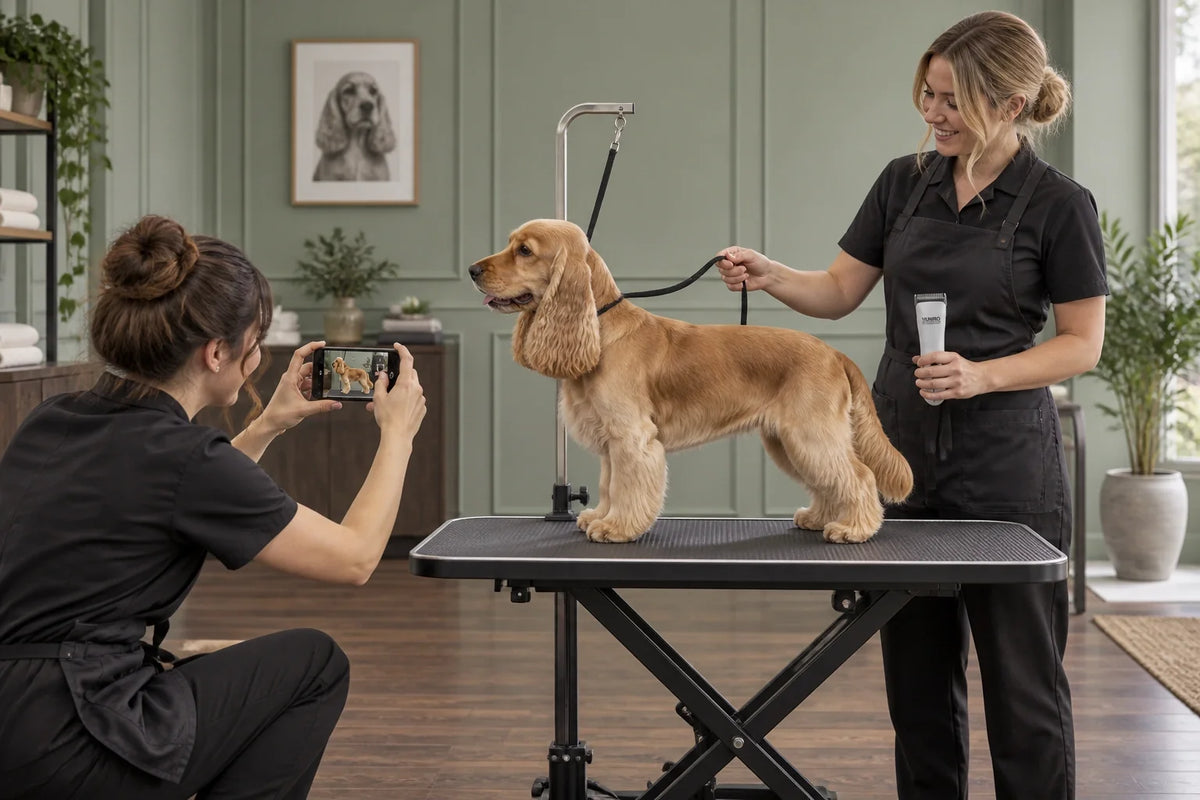
A lovely photograph can be a poor finishing record. Move the camera closer to the head, lower it towards the feet or change the direction of the light, and the same groom can appear to have different proportions.
For a useful handover, take a small set of reference photographs as well as the image you want to post. Their job is to help another groomer understand the shape you actually made.
Camera distance changes the comparison
Perspective depends on where the camera is. If the head is substantially closer to the lens than the hindquarters, it appears larger in relation to them. A wider view taken very close to the dog can exaggerate this difference. Selecting a different zoom setting without considering camera position does not make two views equivalent.
Choose a safe, repeatable place to stand and a similar camera height for each view. Keep enough distance to frame the entire dog comfortably without a very close wide-angle view. Never move the dog into an unsafe position just to match a camera mark.
Guidance on medical photography in the BMJ recommends consistent lighting, suitable overview and detail images, careful focus and protection of image integrity. It concerns human clinical documentation, not dog styling; the transferable point is that the capture conditions affect what a comparison can show. Read the photography guidance.
Give each view a specific job
| View | What it helps preserve | Common trap |
|---|---|---|
| Side profile | Overall silhouette and transitions between body and furnishings | Dog turning towards the camera, shortening the visible body |
| Front | Relationship between chest and front leg furnishings | Comparing legs while the dog leans or steps |
| Rear | Rear outline in a comfortable stance | Forcing a position instead of recording the stance actually shown |
| Selected detail | A specific blend, transition or area to discuss | Losing all landmarks so nobody knows where the detail belongs |
Not every dog will comfortably provide every view. Record a missing view rather than extending handling for the sake of a complete set. A second trained person can take the photographs while the groomer supervises the dog.
Let the coat settle before your reference shot
Decide whether the photograph records a lifted working section or the finished coat at rest. Both can be useful, but they answer different questions. Save a settled view before making a final correction solely because a freshly lifted section looks uneven.
For the same reason, record whether the coat is fully dry and how it was organised before the shot. A glossy side light can reveal a ridge; flatter light may conceal it. Keep the main light direction similar when the purpose is comparison.
A photograph needs its tool notes
“Use the picture” leaves too much unexplained. Add the clipper system, blade, guard where used, direction of work and areas finished by hand. Nominal guard length alone does not describe the whole combination or guarantee the apparent finished length.
For example, a record involving the VUNRO #10 Ceramic D-Series Blade should name the actual blade. If you use the Universal Guard Comb Set, also record its specified standard-width A5 or D-Series #10, #15 or #30 base blade. The universal set is not a wide-blade or trimmer attachment.
A VUNRO coarse/fine comb can serve as your consistent section-checking tool between finishing and photography. Keep the record about how you used it, not a claim that owning a particular comb creates the result.
Keep an original you can trust
Keep the original file alongside any crop used for discussion. Do not smooth the coat, reshape the dog, remove uneven patches or generate a replacement before-and-after image. If a crop removes context, retain the wider view too.
Store client references in your normal restricted client-record system. Obtain appropriate permission before using an identifiable client image publicly, and check the background for names, screens or paperwork. Documentation and publicity need different decisions.
Use the record at the next appointment
Start with the previous views and ask what the client liked, what they found difficult to maintain and what changed. That conversation turns a photograph into a better brief. Repeating an attractive outline is only useful if it still suits the dog and the client's routine.
Sources and scope
Zoltie and colleagues, Medical photography using mobile devices, BMJ, 2022. The grooming view set and tool-note format are practical adaptations, not a validated photographic scoring system.
Keep learning
More from the Blade Blog

A Faster Clipping Pass Is Not Always a Faster Groom
Read the guide →
From Used Tool to Ready Tool: Close the Gaps in the Care Process
Read the guide →


